Pure Madras - encres et tissus
La généalogie, propice à interroger les liens filiatifs, est un thème, un outil, que j'entends utiliser afin de montrer les perceptions de l'identité, de la filiation, de la transmission et de la transformation. En tant que binational déraciné, issu de cultures, classes et nations différentes, touché par le syndrôme de l'exil, j'ai eu dès mon plus jeune âge un questionnement identitaire fort. La pratique de la généalogie fut pour moi certainement salutaire dans ma recherche identitaire. J'ai découvert ainsi un puissant outil d'explication tant de ma petite histoire que de la grande histoire. Aujourd'hui c'est en tant qu'artiste que j'use de la généalogie, par la présentation d'arbres généalogiques fictifs posant le doigt sur divers thèmes liés à l'identité et à la perception de cette identité filiative. Les thèmes posés sont autant de réflexions philosophiques autour de la transmission, de l'orgueil, du changement, de la diversité, de la culture...
Dans cette série, je jouerai volontiers sur la connotation souvent auréolée de prestige des généalogies royales ou nobiliaires. Parfois au contraire, je tenterai de la contourner pour montrer une image moins enjolivée, et plus proche de la réalité des choses, au-delà des perceptions partielles et des habituels faux-semblants. L'outil même de la généalogie est à mon sens aussi utilisable pour montrer les éléments constitutifs et l'historique d'évolution non pas seulement de personnes ou de groupes, mais aussi d'objets ou d'idées, de concepts. Les matériaux utilisés pour mes tableaux généalogiques et filiatifs seront divers. Parfois il s'agira d'objets ou d'éléments détournés de leurs fonctions originelles, comme des cartes à jouer, des pièces de tissus, ou même des stickers, des photos. Mes compositions au thème généalogique sont donc des tableaux assemblant ces divers objets choisis, sur un fond dessiné ou peint, aux techniques variées (aquarelle, lavis d'encre, dessin à la mine de plomb, pastel, peinture acrylique et autres).
Genealogy, conducive to questioning filial links, is a theme, a tool, that I intend to use to show perceptions of identity, filiation, transmission and transformation. As an uprooted dual national, from different cultures, classes and nations, affected by the syndrome of exile, I had strong questions about identity from a very young age. The practice of genealogy was certainly beneficial for me in my search for identity. I thus discovered a powerful tool for explaining both my little story and the big story. Today it is as an artist that I use genealogy, through the presentation of fictitious family trees pinpointing various themes linked to identity and the perception of this filiative identity. The themes posed are all philosophical reflections around transmission, pride, change, diversity, culture...
In this series, I will happily play on the often prestigious connotation of royal or noble genealogies. Sometimes, on the contrary, I will try to circumvent it to show a less embellished image, and closer to the reality of things, beyond partial perceptions and the usual pretenses. In my opinion, the very tool of genealogy can also be used to show the constituent elements and the history of evolution not only of people or groups, but also of objects or ideas, concepts. The materials used for my genealogical and filiative tables will be diverse. Sometimes these will be objects or elements diverted from their original functions, such as playing cards, pieces of fabric, or even stickers, photos. My compositions with a genealogical theme are therefore paintings assembling these various chosen objects, on a drawn or painted background, with varied techniques (watercolor, ink wash, graphite drawing, pastel, acrylic painting and others).
Pur Bourbon - Pure Bourbon
Peinture à l'encre et cartes à jouer.
Ink painting & playing cards
65 x 50 cm. C. 2016.
Original disponible à la vente.
The original piece is available on sale.
Original 800€
Tirage numéroté 250€
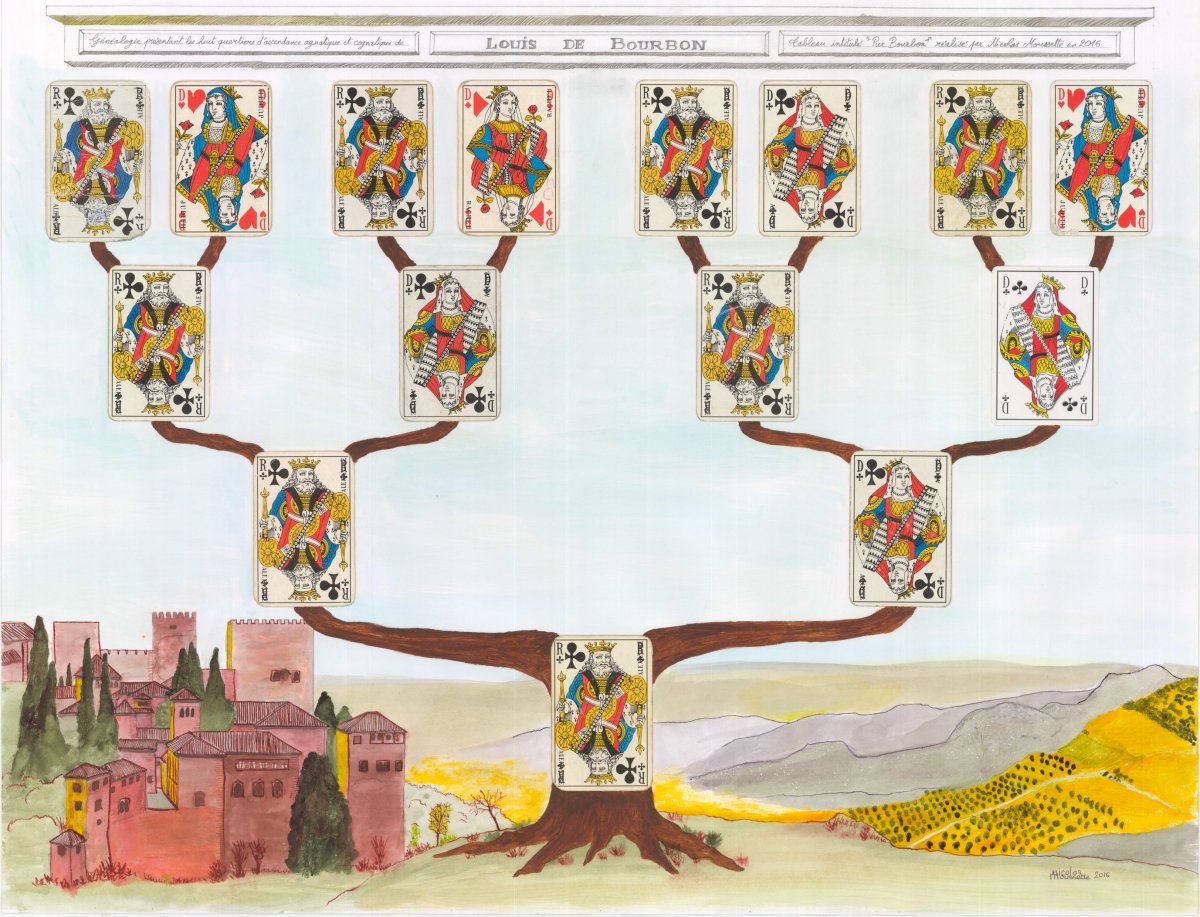
Pur Bourbon est un exemple typique d'endogamie telle qu'elle fut pratiquée dans l'aristocratie européenne, et justement chez les bourbon, notamment les Bourbons d'Espagne. D'où la représentation de l'Alhambra de Grenade ici, qui nous ancre dans ce contexte espagnol. Cette généalogie "pur Bourbon", ici représentés par les cartes "trèfles" ne laisse en effet que peu de place à d'autres ascendances. Louis n'est que le prénom emblématique et le plus courant utilisé par les Bourbons, ainsi ce peut être n'importe lequel de la dynastie, et aussi les Bourbons français, également très intermariés. Le caractère désertique du paysage correspond bien à mon avis à la pauvreté génétique qu'induit une telle endogamie. Et le château représente le sang dynastique bien protégé de l'extérieur !
With this art piece representing a genealogy on four generations, playing cards replace the portraits or photos of ancestors. I always found the figures of playing cards very beautiful in their hieratic styles of kings, queens, and even valets in majesty. They are true characters, and each of them has a little name, mostly after heroes of the past or the Bible.
Here, this fantasy genealogy of a possible Louis de Bourbon (half of the Bourbon were named Louis, so it could be virtually any of them, or none), matches well the spirit of the playing card figures: fame and glory goes well with dynastic genealogy.
One might discover that there are only kings of Clubs: all Bourbon of course. The rest are ladies from other families, in the fourth generation, but beneath everyone is already Clubs, or Bourbon. The effect created is one of great harmony.
Nevertheless, this reflects the very frequent endogamy of the Bourbon family, who intermarried all the time in recent or past history. This might have favoured the dynastic wealth and keeping crowns and property within the family, but surely also had an impact on health of its individuals... This was the case of the Bourbons of Spain in the XVIII and XIX centuries... Hence the spanish castle and landscape, which baren character mirrors the genetic aridity of over-repeated bloodlines, progressively depleting the soil / blood from its nutrients and life.
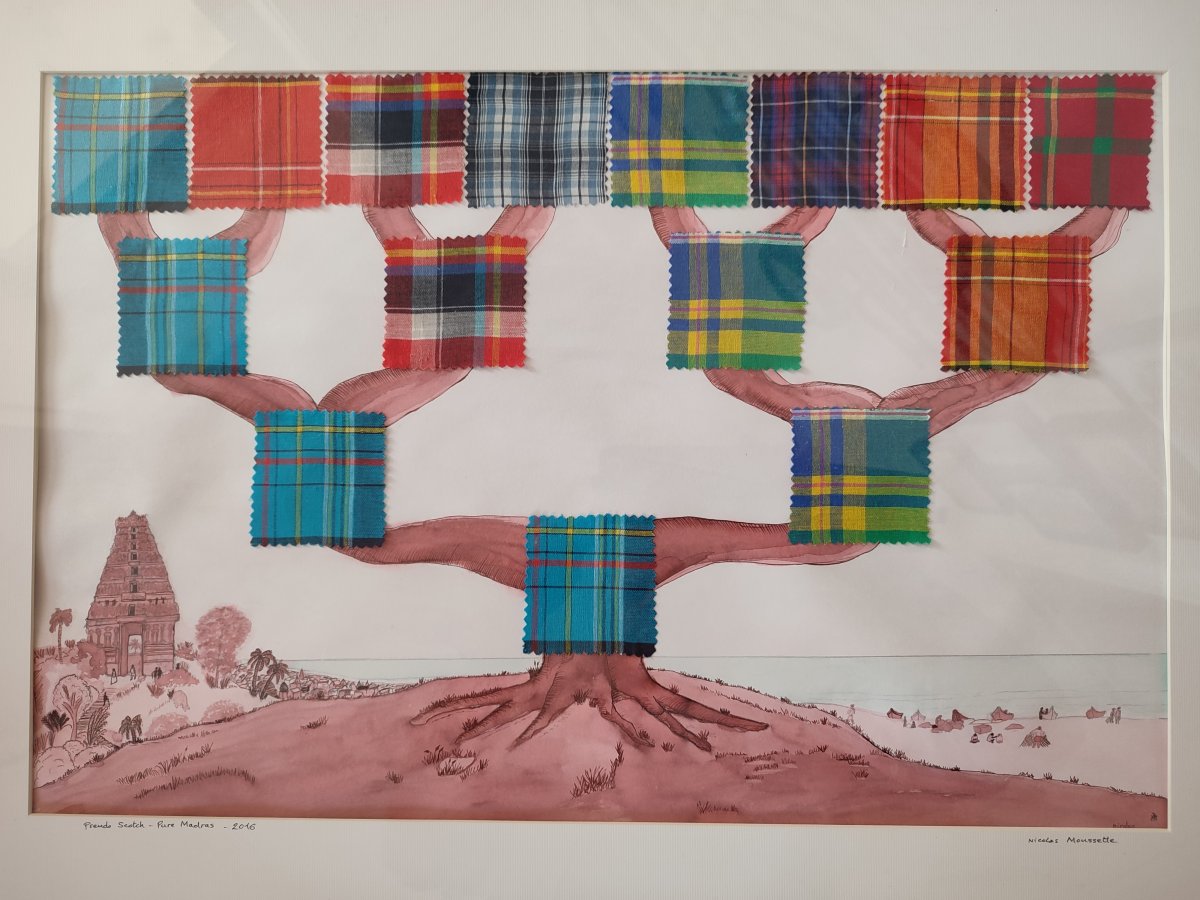
Pseudo Scotch - Pure Madras
Peinture à l'encre et tissus.
Ink painting & Fabric
65 x 50 cm. C. 2017.
Original disponible à la vente.
The original piece is available on sale.
Original 800€
Tirage numéroté 250€
Pseudo Scotch - Pure Madras présente plutôt une généalogie d'Indiens que d'Ecossais. En effet, le tissu "Madras", introduit dans le Sous-continent indien par les Britanniques au XVIIIème siècle, a fait des émules... J'aime ces couleurs vives qui respectent les règles d'élaboration des beaux tartans. Ici sous les tropiques, le coton léger a cependant remplacé la chaude laine des Highlands. Mais quelle ne fut pas ma surprise en discutant avec une authentique indienne de Madras d'apprendre que ces tissus ne sont en fait pas portés à Madras, mais aux Antilles !
Pseudo Scotch - Pure Madras presents the genealogical background of an Indian person, rather than of a Scott! Effectively, the fabrics look like scottish tartan, but are really so called "Madras" fabrics... For the story, this fabric's origins are to be found in the Indian subcontinent colonized by the British in the XVIIIth century, where tartan was among the favorites, notably with military men. It survived and developed there until the present day, respected the strict rules of tartan making, in parallel of the scottish and western production centers. I particularly love the bright colours of the Madras tartan style. Under tropical climate, light cotton has replaced the thick wool of the scottish Highlands.
But what was my surprise when I discussed the point with an authentic Indian woman from Madras who told me those fabrics are never seen in Madras... but rather in the West Indies!
Pure American
Peinture à l'encre et tissus.
Ink painting & Fabric
65 x 50 cm. C. 2017.
Original disponible à la vente.
The original piece is available on sale.
Original 800€
Tirage numéroté 250€
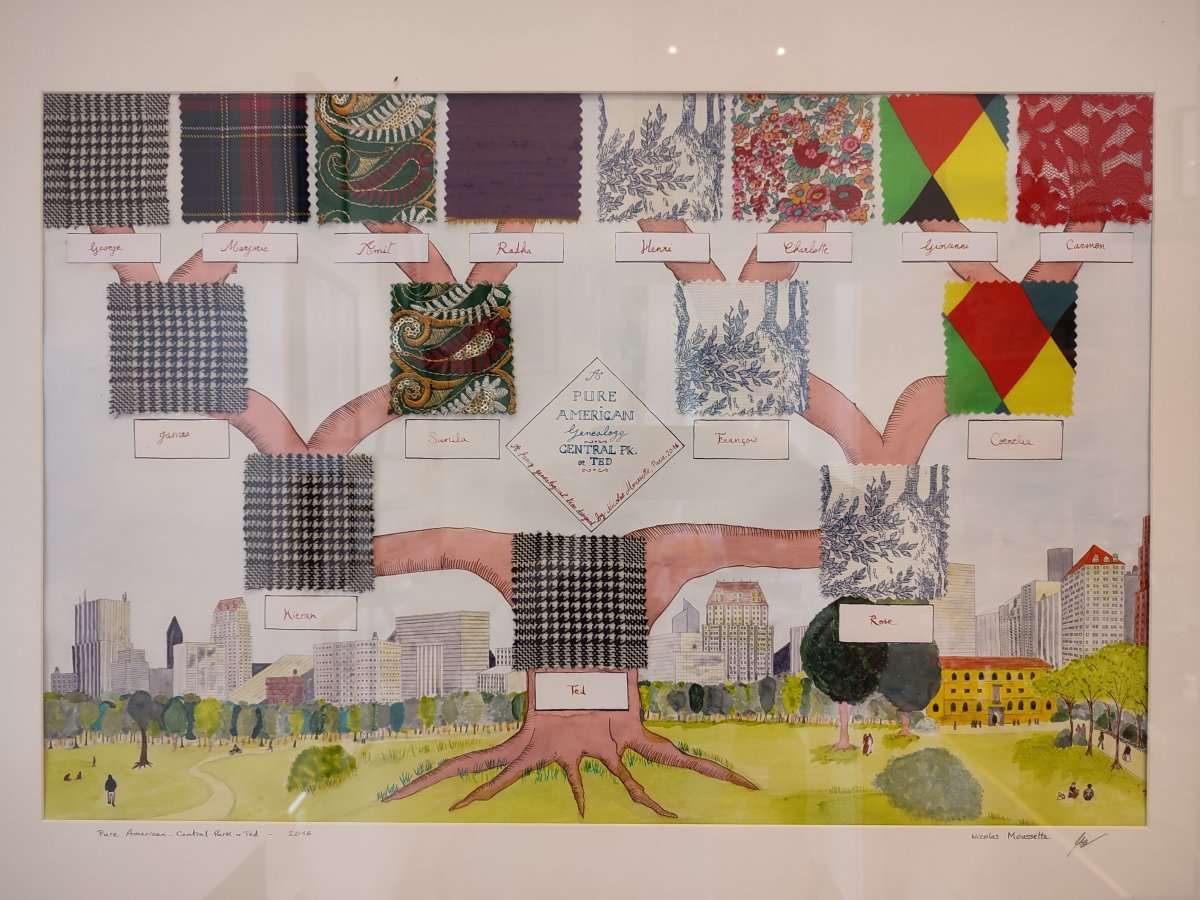
Pure American - Central Park, montre bien ce qu'est, la plupart du temps, un habitant des Etats-Unis d'Amérique: un melting pot de diverses origines. Le probant ici est Ted, habitant de New York, près de Central Park. Il est plutôt de la bonne société, nonobstant quelques origines assez originales. Sa lignée paternelle mêle les sangs anglais (le tissu "Prince of Wales" créé pour les grands propriétaires anglais en Ecosse et frustrés de ne pouvoir porter le tartan !), et écossais (tartan) avec du sang indien (tissus de soie et aux motifs typiques). Sa ligne maternelle est, quant à elle, plutôt méditerranéenne: français pour moitié (toile de Jouy, et motif à fleurs) et italo-espagnole (carnaval italien et dentelles ibériques) en lignée matriarcale.
I love the colours, patterns, and different feel of fabrics. But I love even more the identity and culture it bears. It is sometimes much easier to identify a person, a group, a family, a region... with a fabric than any other object. From fabric to costume there is just another step forward... I like to explore this aspect of human identity as widespread as it is unknown.
The collage Pure American - Central Park, shows quite well who are, in many cases, the modern inhabitants of the U.S.A. : a true melting pot of multiple origins. The probant here is Ted, a New Yorker, near Central Park. The creation represents his genealogy on three generations above himself. Ted is rather from a wealthy background, but with some peculiar origins. His father line mixes English (the "Prince of Wales" fabric created for english landlords in Scotland frustrated of not having tartans!), Scottish (tartan) with Indian blood (silk and typical patterned fabrics). Ted's mother line is rather mediterranean: French (with the "toile de Jouy" pattern), possibly English again (with the "Liberty" flowered pattern), and Italian-Spanish (Italian carnival and iberic lace)...
Chains of Generations
Peinture acrylique sur toile - chaînes de métal et cadenas
Acrylic painting on canvas - metal chains and lockers
50 x 40 cm. C. 2017.
Original disponible à la vente.
The original piece is available on sale.
Original 1800€
Pour mes "psychogénéalogies", je reprends bien entendu le moyen de l'arbre généalogique, pour traiter de divers thèmes qui ont trait à la psychologie collective familiale, aux thèmes de l'identité et de la transmission. Les matériaux utilisés pour mes tableaux de psychogénéalogie seront divers. Parfois il s'agira d'objets ou d'éléments détournés de leurs fonctions originelles, comme des loquets, des chaines, des cartes à jouer, des pièces de tissus, ou même des stickers, des photos. Mes compositions thématiques sont donc des tableaux assemblant ces divers objets choisis, sur un fond dessiné ou peint, aux techniques variées (aquarelle, lavis d'encre, dessin à la mine de plomb, pastel, peinture acrylique et autres).
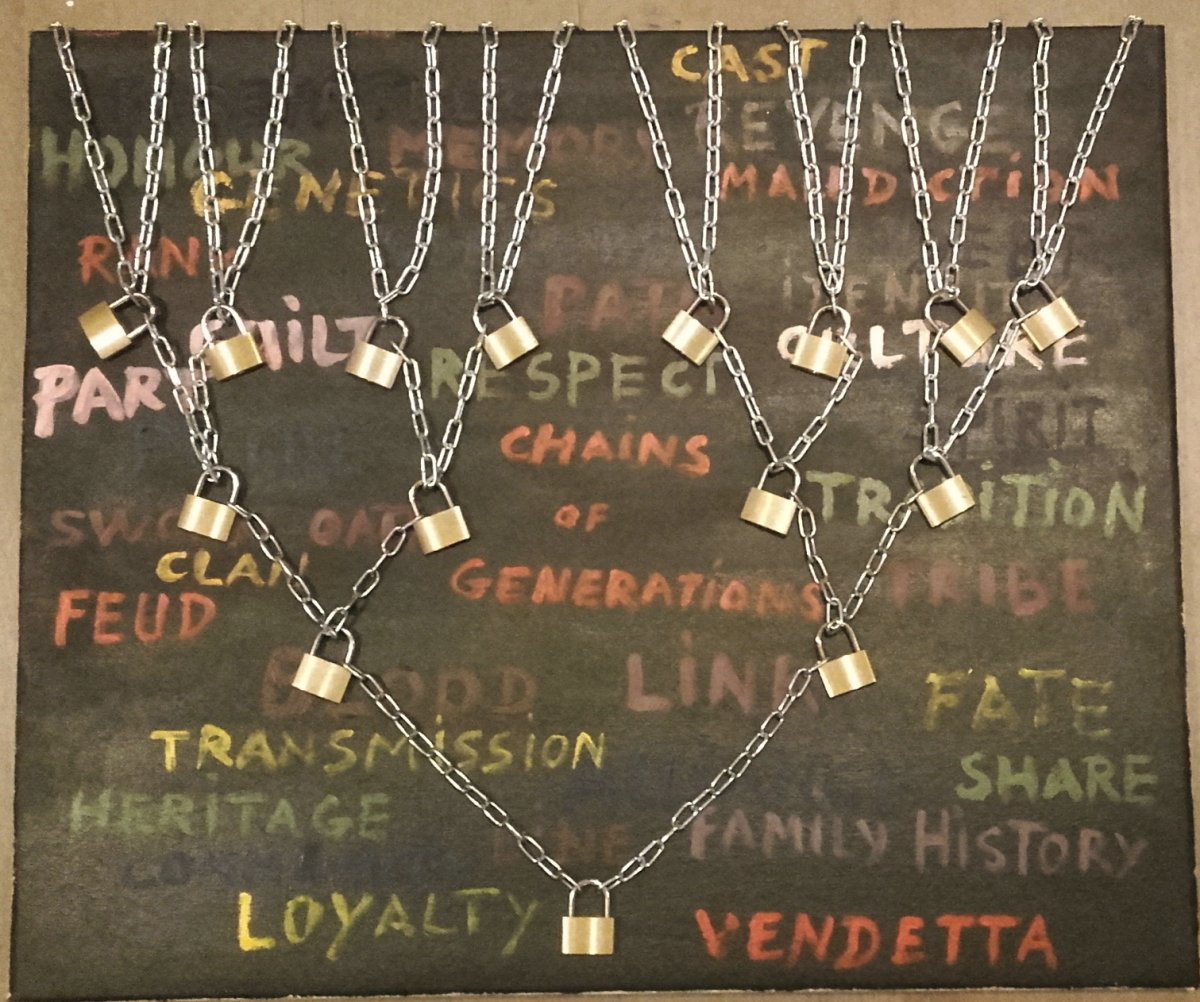
Chains of Generations est une pièce forte et psychanalytique. C'est assez sombre car son thème porte sur des personnes enchaînées par leur passé. L'image représente une généalogie sur quatre générations où tous les gens sont des serrures et les liens entre eux sont des chaînes. A chaque génération, pour chaque maillon, il y a un verrou entre les chaînes. Dans cette famille, les valeurs – ou les problèmes – sont les mêmes de génération en génération et transmis à la suivante sans discussion.
La toile est peinte en noir, avec des mots colorés éparpillés dessus, comme les nombreuses raisons ou prétextes de la préservation sans fin de ces valeurs. Toujours ce choix (de ne pas avoir de choix personnel !) semble bien assumé : les chaînes et les serrures sont impeccablement propres, parfaitement uniformes et positionnées dans un contrôle et un ordre sans faille. Dans cette image, le grand gagnant est l’ordre, le respect, probablement un culte du passé et la résistance aux changements. Parfois cependant, s’il est sage d'assumer son passé, il faut savoir que nous ne sommes pas responsables des actes de nos ancêtres. Il est bon de briser les chaînes héritées que nous pourrions avoir, afin de libérer l’esprit et le cœur.
Chains of Generations is a strong, psychanalytic piece. It is quite dark as its theme is about people enchained by their past. The picture represents a genealogy on four generations where all the people are locks and the links between them are chains.
At each generation, for each link, there is a lock between chains. In this family, the values - or problems - are the same through generations and passed on to the next without discussion. The canvas is painted black, with coloured words scattered on it, as the many reasons or pretexts for the endless preservation of those values. Still this choice (of not having a personal choice!) appears to be well assumed: the chains and the locks are immaculately clean, perfectly even, and positioned in total control and order.
In this picture, the great winner is order, respect, probably a worship of the past, and resistance to changes.
Sometimes though, if it is wise to assume its past, we are not responsible for our ancestors' deeds. It is good to break the inherited chains that we might have, in order to free the mind and unleash the heart.
+33 6 29 05 76 23
nimou7@gmail.com
3 rue Gounod 92210 Saint-Cloud